
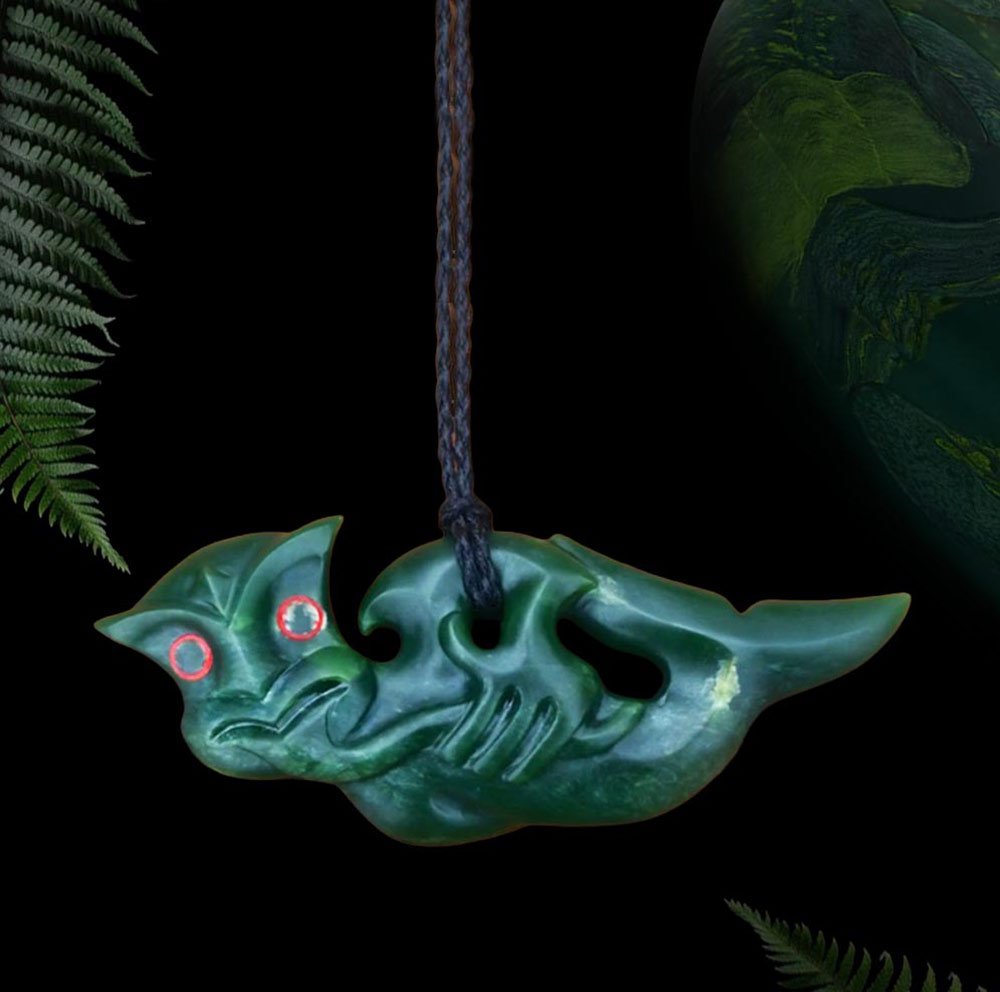
The Marakihau in Māori Tradition
Taniwha are powerful beings associated with water: rivers, lakes, harbours and the sea. Some were guardians of a particular people or place, while others were dangerous to anyone who failed to show respect. Many iwi have their own taniwha, tied to specific waters.
The marakihau belongs to the sea. Traditional accounts describe it drawing in fish, and even canoes, through its long tongue. In carving, the same form was also used to depict known taniwha: a carving of Ureia, a powerful taniwha of the Firth of Thames, is carved in the marakihau style on the Hotunui meeting house.
Not everyone reads the marakihau as a taniwha. Te Ara notes that some see marakihau figures as ancestors, with a serpent-like body reflecting the idea that people have origins in the water. This double reading, sea creature and ancestor, is part of what makes the design so rich.
What Does the Marakihau Mean?
In pounamu, the marakihau is most often linked with:
Like taniwha themselves, the marakihau has two sides. It can stand for protection, the guardian that watches over those who treat the sea with respect, and for the danger of approaching powerful forces carelessly. Many wearers see it less as a good luck charm and more as a reminder to approach the sea, and life's bigger forces, with humility.
Some carvers and wearers also connect the marakihau with transformation and change. These meanings vary between carvers and iwi, and no single interpretation is accepted by everyone.

The Marakihau in Carving
The marakihau has a set of features that make it easy to recognise:
Most historic marakihau are found in wood carving, particularly on meeting houses, where the figure could be shown at large scale. In pounamu, carvers adapt the form to a pendant, sometimes keeping every detail and sometimes simplifying it to the head, tongue and curling tail. Because of the sinuous shape and fine detail, it is one of the more demanding designs to carve in such a hard stone. You can read more in our guide to how pounamu is carved.
The marakihau sits alongside other designs that draw on figures from between worlds, such as the manaia and the pekapeka.
Choosing a Pounamu Marakihau
Look for a carving where the main features are clear and confident: the head, the tongue and the curl of the tail should all read well at a glance. Many people like stones that suggest water, such as kawakawa with deep internal patterning, or translucent tangiwai. Our guide to types of pounamu explains the main varieties.
Because the marakihau is a complex design, quality varies a lot between carvers. Before buying, read how to choose a pounamu pendant and how to tell if pounamu is real.
Other Pounamu Designs
Explore the meanings behind other traditional forms: