The Pekapeka: Rarity, Night Guardianship & Connection to the Spirit World

The pekapeka is one of the rarest and most intriguing pounamu designs. Named for the long-tailed bat (Chalinolobus tuberculatus), one of only two native land mammals in New Zealand, and among the country’s most endangered species, the pekapeka carries the meanings of its namesake: rarity, the guardianship of the night, and the connection between the living world and the world of spirits.

The bat is a creature of twilight and darkness, a navigator of invisible spaces, at home between the visible and invisible worlds. In Māori tradition, the pekapeka was associated with the spirit world and with those who could move between realms, making it a design of quiet but profound spiritual power. (read more: The Manaia)

pekapeka meaning greenstone pounamu

The Long-Tailed Bat in Aotearoa

New Zealand’s pekapeka, the long-tailed bat, is one of the world’s smallest bats and one of the oldest surviving mammals in the country’s ecosystem. It is a creature of the forest edge, hunting moths and insects on the wing with extraordinary agility. Its long tail, which gives it its common name, is used as a pouch to catch insects mid-flight, a remarkable piece of evolutionary engineering.

The rarity of the pekapeka in the wild gives the pounamu design its first meaning: something precious and rare, not often seen, requiring care and attention to appreciate. Like the bat itself, the pekapeka design rewards those who take the time to understand it.


Meaning: Spiritual Connection and Liminal Guardianship

Bats are universally liminal creatures, they live between day and night, between the visible and invisible, between the world of the living and the world of the dead. In many cultures worldwide, bats are associated with the spirit world and with those who can navigate it. In Māori tradition, the pekapeka was similarly understood as a creature that moved between worlds, and wearing its form in pounamu carried those associations. (read more: Benefits of Wearing Pounamu)

The pekapeka is therefore a design for those who navigate complexity and ambiguity, who are comfortable in uncertain or in-between spaces, and who have a genuine connection to the less visible dimensions of life. It honours the ability to find one’s way in the dark.

Pekapeka as a Unique New Zealand Symbol

Because the long-tailed bat is found only in New Zealand, the pekapeka design is uniquely connected to Aotearoa in a way that few other pounamu forms are. It does not appear in other Polynesian carving traditions, it belongs entirely to the ecology and culture of this particular place. Wearing a pekapeka is therefore an expression of deep connection to New Zealand itself.

For New Zealanders abroad or for visitors who have formed a strong connection to Aotearoa, the pekapeka carries this place-based meaning alongside its spiritual associations. It is a design that says: I belong to this land, and this land’s most rare and precious creatures are part of who I am.


The Pekapeka in Pounamu Carving

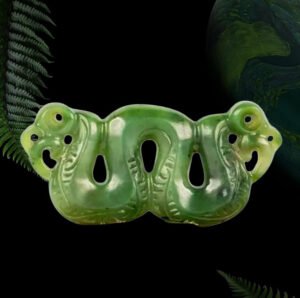
The pekapeka is a relatively rare pounamu design compared to more common forms like the koru or hei matau, which makes it especially appropriate given its namesake’s rarity in the wild. Carvers who work with the pekapeka form often emphasise the creature’s wings and the distinctive elongated tail in the carving, creating a piece that is clearly identifiable while remaining abstract enough to work as jewellery. (read more: Marakihau)

As a design, the pekapeka pairs naturally with the kōauau in the sense that both are associated with creatures of the air and with spiritual communication. Both also carry a quality of rarity and depth that sets them apart from more commonly known pounamu forms. (read more: The Kōauau)

Pounamu Resources

Explore authentic greenstone carvers, galleries and shops across New Zealand.

Who Should Wear a Pekapeka?

The pekapeka is ideal for those who feel a kinship with the night, with rare and unusual things, or with the spaces between the visible and invisible worlds. It is a design for people who are naturally drawn to the mysterious and the liminal, who navigate complexity with grace and who have a spiritual dimension that not everyone sees.


Choosing a Pounamu Pekapeka

The pekapeka works particularly well in darker stones, kawakawa or pounamu with dark, complex patterning, that evoke the creature’s nocturnal nature. The design is most effective when the carving clearly suggests the bat’s distinctive form: outstretched wings, elongated body, and that characteristic tail. A well-executed pekapeka in fine pounamu is a genuinely rare and beautiful piece. (read more: Types of Pounamu)

For the right person, the pekapeka is one of the most distinctive pounamu gifts available, unusual, deeply meaningful, and connected to the wild heart of Aotearoa. (read more: What Is Pounamu?)

Frequently Asked Questions About the Pekapeka

What does the pekapeka mean in pounamu?

The pekapeka is named after the long-tailed bat, one of New Zealand’s rarest native mammals. As a pounamu design, it symbolises rarity, spiritual connection, liminal guardianship (the ability to navigate between worlds), and deep connection to Aotearoa New Zealand.

The pekapeka (bat) was understood as a creature of the twilight — moving between the visible and invisible worlds. In Māori tradition, it was associated with the spirit world and with those who could navigate unseen realms, giving the design its spiritual associations.

No — the pekapeka is one of the less common pounamu designs, which makes it particularly fitting given that the long-tailed bat itself is one of New Zealand’s most endangered species. Its rarity in pounamu carving mirrors the rarity of its namesake in the wild.

The pekapeka is ideal for people who feel drawn to the unusual and the mysterious — those who are comfortable in the spaces between certainty, who have a strong spiritual dimension, or who have a deep personal connection to New Zealand’s unique natural world.

Darker pounamu stones — kawakawa or stones with complex, dark patterning — suit the pekapeka’s nocturnal associations well. The most important quality is that the carving clearly expresses the bat’s distinctive form. (read more: Types of Pounamu)

No — the long-tailed bat is endemic to New Zealand, so the pekapeka design is uniquely Māori and uniquely connected to Aotearoa. It does not appear in other Polynesian carving traditions, making it one of the most distinctly New Zealand of all pounamu designs.