Carve Your Own Pounamu Necklace: Workshops Across New Zealand
11 min read
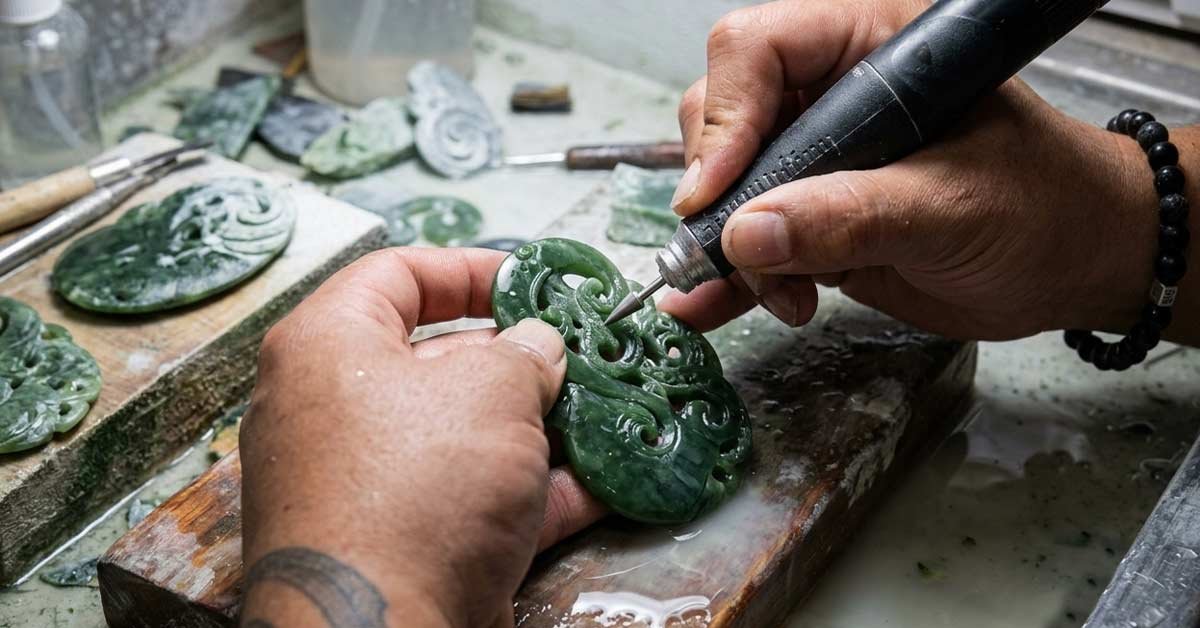
Shaping a pendant on the grinding wheel at Te Koha, near Franz Josef. Photo: Te Koha Aotearoa
You can carve your own pounamu necklace at a handful of guided workshops around New Zealand, most of them on the South Island's West Coast. In two to five hours, a carver helps you choose a stone, shape it on water-cooled grinding wheels, polish it and string it, and you leave wearing the finished piece.
This guide covers what actually happens in a session, how long it takes, what you take home, and where to book, from full carving sessions in Hokitika, Franz Josef and Napier to a shorter studio experience in Rotorua. It also covers the question most visitors never think to ask: whether the workshop is using genuine New Zealand pounamu, which only comes from the South Island.
Every workshop featured here is listed in our directory, with a link to book directly with the business.
Quick Takeaways
No carving experience needed at any of these workshopsFull carving sessions run from about 2 to 5 hoursYou leave wearing your finished pendant on a cordAsk where the stone was sourced before you bookBook ahead in summer, especially on the West Coast
What Is a Carve-Your-Own Pounamu Workshop?
A carve-your-own pounamu workshop is a guided session in a working carving studio where you shape a raw piece of pounamu (New Zealand greenstone) into a pendant yourself, using the same diamond wheels and rotary tools the carvers use. A tutor stays with you the whole way, steps in on the tricky parts, and finishes the drilling and cording so the piece is ready to wear.
Most sessions are built for complete beginners. You don't need drawing skills or a steady hand to come away with something you're proud of, and the result is a one-off piece that no shop could sell you, because you made it.
Not every experience marketed as "carve your own" involves a full carve, though. Some are shorter studio tours where you shape a stone briefly by hand and string a piece that was carved and polished beforehand. Both have their place, so it helps to know which one you're booking.
What Happens in a Session
Every studio runs things a little differently, but a full carving session generally follows the same path a professional carver takes, just slowed down and guided. If you'd like the full background first, our guide on how pounamu is carved covers the craft in more depth.
An introduction to pounamu. Most sessions open with the story of the stone, where it comes from, and the meanings behind traditional forms such as the koru, toki and hei matau.
Choosing your stone. You pick a slice or pebble from the studio's selection. Many carvers talk about letting the stone choose you, so take your time here.
Planning the design. You sketch your shape on paper, often from a folder of examples, then transfer the outline onto the stone.
Rough shaping. Wearing safety glasses and ear protection, you grind the outline on water-cooled diamond wheels. This is the loud, wet part.
Detail work. Curves, holes and grooves are cut with a handheld rotary tool. Your tutor will usually help with anything delicate, such as the inside of a koru.
Sanding and polishing. Progressively finer sanding brings out the colour and depth of the stone. This stage takes patience and makes the biggest difference to the finish.
Drilling and cording. The studio drills the hole and binds or strings the pendant, so you can put it on before you leave.
Rough shaping on a water-cooled grinding wheel at Pou Creations, Napier. Photo: Pou Creations
How Long Does It Take?
Plan on about two hours for a simple shape and anywhere up to five hours for a detailed design. Pounamu is a very tough stone, so time depends mostly on what you choose to carve: a roimata (teardrop) or toki (adze) with smooth outlines is far quicker than a koru, pikorua or anything with open holes and fine curves.
A few practical points shape how long your session runs:
Simple outline: about 2 hoursDetailed design: 3 to 5 hoursStudio tour and stringing: under an hour
Having a design in mind before you arrive saves real time. Browsing our guide to pounamu designs and meanings the night before is an easy way to start.
These five experiences are all run by businesses listed in our directory. Durations and age limits below were checked with each business's own booking information, but they can change, so confirm when you book. We've left prices out because they change often; expect a full carving session to cost noticeably more than a short studio tour.
Carve-your-own pounamu experiences at a glance
Workshop
Where
What you do
Time
Ages
Bonz 'n' Stonz
Hokitika, West Coast
Full carve of your own design
Up to 5 hours
10+ with a parent; under 10 polishing only
Arahura Greenstone Tours
Arahura, near Hokitika
River walk, then make a necklace from the stone you find
2 or 4 hour tours
Ask when booking
Te Koha Aotearoa
Franz Josef, West Coast
Full carve from a stone you choose
About 2 hours, allow 2.5
14+ per its booking page
Pou Creations
Napier, Hawke's Bay
Full carve, sand and polish
About 2 hours
10+ with parental supervision
Mountain Jade
Rotorua, Bay of Plenty
Studio tour, hand-shaping demo, string a pre-carved piece
About 40 minutes
All ages
West Coast (Te Tai o Poutini)
The West Coast is the home of pounamu, and the region with the most carving studios. If your South Island itinerary includes the glaciers or Hokitika, this is the natural place to carve. See our West Coast region guide for every carver and gallery in the area.
Bonz 'n' Stonz, Hokitika
Full carveUp to 5 hoursPounamu, bone or shell
Master carver Steve Gwaliasi opened Bonz 'n' Stonz on Hamilton Street in 2000, and it is one of the longest-running carve-your-own studios in the country. You design your own piece, pick your stone, and work through each stage with a tutor beside you. The carve-your-own price covers the stone, tuition, up to five hours of workshop time and stringing, so this is the one to choose if you want a detailed design and the time to do it properly. Visitors often report needing three to four hours. Children under 10 can join in the polishing only, and those 10 and over need a parent with them throughout. The studio also carves bone and shell, so say clearly that you want pounamu when you book.
This one is different from a studio session. Guides with generations of connection to the river walk you from Arahura Bridge Heritage Park through the Arahura Pā and along the Arahura River, sharing the history and pounamu stories of Kāti Waewae, the hapū whose stories are tied to this river. You learn to recognise pounamu in its natural setting, then make a necklace from the piece of stone you found. It is less about carving technique and more about meeting the stone where it comes from. Two honest notes: expect wet feet, and the stone you find on the day may be pounamu or another river stone, which your guide will help you identify. The Arahura is not a public fossicking spot, so this is a river to visit with its own people as guides.
The Goodall whānau have run Te Koha (formerly Te Koha Gallery) as a carve-your-own studio since 2010, now on their family farm on Waiho Flat Road just outside the Franz Josef township. Sessions start with the meanings of pounamu and its traditional forms, then you choose a stone, plan your design, and move into the machine room for grinding, rotary-tool detail, polishing and cording. Much of the pounamu used comes from West Coast riverbeds. At around two hours (allow up to two and a half), it fits neatly around a glacier day, and it is a popular choice when weather grounds the helicopters. A courtesy van from Franz Josef is available. Its booking page lists a minimum age of 14, so check before booking with younger children.
Pounamu is not found naturally in the North Island, but it has been traded and treasured there for generations. These two studios carve stone brought up from the South Island.
Pou Creations, Napier
Full carveAbout 2 hoursCruise-friendly times
Pou Creations is a whānau-led carving studio and gallery on Emerson Street in central Napier, run by Teina Marsters and Nancy Rakete-Stones. Carving sessions take place in the workshop behind the gallery, where you choose your stone, learn its meaning, then shape, sand and polish it with Teina's guidance. The studio says its pounamu comes from the West Coast. Drilling and binding of your finished piece are included, the minimum age is 10 with parental supervision, and session times are set up to suit cruise passengers, which makes this one of the easiest full carving experiences to fit into a port day. Bookings are essential, though walk-ins are possible when there is space.
Mountain Jade's Highlights Tour is not a full carve, and it is worth knowing that before you book. On this guided studio tour on Fenton Street you meet the resident carvers, watch a live carving demonstration, try shaping pounamu by hand with sandstone the traditional way, then choose a piece that has already been carved and polished and learn to string it into a necklace. It suits anyone short on time, families with young children, and visitors who would rather watch skilled carvers than operate the machinery themselves. The studio warns that the high-pitched carving machinery may not suit people with sensitive hearing.
How to Choose a Workshop That Uses Genuine Pounamu
Genuine pounamu comes only from the South Island, mostly from the rivers and coast of the West Coast. Under the Ngāi Tahu (Pounamu Vesting) Act 1997, pounamu in its natural state within the Ngāi Tahu takiwā belongs to Ngāi Tahu. Meanwhile, much of the green stone sold around New Zealand is nephrite jade imported from places such as Canada, which looks very similar once it is cut. A workshop is only as authentic as the stone on its bench, so a few questions before booking are worth it:
Where was this stone sourced?Is it New Zealand pounamu?Will I choose my own piece?Is it a full carve or pre-carved?
A reputable studio will answer clearly and without hesitation. Some studios also carve bone, shell or other New Zealand stones, which is perfectly fine, but if pounamu is what you want, make sure that is what you are working with. For more on spotting the difference, see our guide on how to tell if pounamu is real.
Carving a Taonga for Yourself, or for Someone Else
You may have heard that pounamu should always be given as a gift and never bought for yourself. It is a widely shared tradition, and gifting pounamu does carry special meaning, but there is no single rule, and views vary between iwi, carvers and families. Many people today buy or carve pounamu for themselves, and our guide on whether you can buy pounamu for yourself looks at this question in more detail.
For many visitors, carving their own piece sits comfortably between the two. Some people see the hours spent shaping the stone as a way of putting their own effort and intention into it, which can make it feel earned rather than simply bought. Others choose to carve a piece for a partner, child or friend, so it can still be given as a gift. Couples carving pendants for each other is a common sight in these studios.
Whichever way you go, what matters most to most practitioners is approaching the stone with respect. Listening to the stories your tutor shares, learning what your design means, and treating the finished piece as a taonga rather than a souvenir are good places to start.
Tips Before You Book
Book ahead in summer. Studios are small and sessions fill quickly between December and March. Bonz 'n' Stonz, for example, suggests booking up to a week ahead in summer and a day ahead in winter.
Wear clothes you don't mind getting splashed. Grinding is done wet, and fine stone slurry gets everywhere. Tie back long hair and leave dangling jewellery off.
Use it as your wet-weather plan. West Coast rain is famous, and an indoor carving session is one of the best things to do when walks and flights are cancelled. River tours like Arahura's still run in light rain but depend on conditions.
Check age limits for children. They range from all ages for a studio tour to 14 and over for some full carving sessions.
Ask about care. Your tutor will tell you how to look after the cord and stone, and our guide to caring for pounamu covers the rest.
Frequently Asked Questions about Carving Your Own Pounamu
Most carve-your-own pounamu workshops are on the South Island's West Coast, including Bonz 'n' Stonz in Hokitika and Te Koha Aotearoa near Franz Josef, with Arahura Greenstone Tours offering a river walk and necklace-making experience near Hokitika. In the North Island, Pou Creations in Napier runs full carving sessions, and Mountain Jade in Rotorua offers a shorter studio tour where you string a pre-carved piece. See our West Coast region guide for more carvers in the area.
A simple shape such as a roimata or toki usually takes around two hours, while a detailed design with curves or open holes can take three to five hours. Pounamu is a very tough stone, so the design you choose matters more than anything else. Arriving with a design in mind shortens the session.
No. Carve-your-own workshops are designed for complete beginners. A tutor guides you through each stage, from choosing the stone and drawing the design to grinding, polishing and cording, and helps with any delicate detail work. Safety glasses and ear protection are provided.
It depends on the workshop. Bonz 'n' Stonz lets children under 10 join in polishing only, and those 10 and over can carve with a parent present. Pou Creations accepts ages 10 and up with parental supervision, while Te Koha's booking page lists a minimum age of 14. Mountain Jade's studio tour suits all ages. Confirm the current age limit when you book.
There is a well-known tradition that pounamu should be gifted, but there is no single rule and views vary between iwi, carvers and families. Many people carve a piece for themselves, and some see the time spent shaping it as a way of putting their own intention into the stone. Others carve one to give away. Our guide on whether you can buy pounamu for yourself covers this in more detail.
Ask where the stone was sourced before you book. Genuine pounamu comes only from the South Island, and a reputable studio will tell you clearly where its stone comes from. Some studios also work with bone, shell or other stones, so confirm you will be carving pounamu. Our guide on how to tell if pounamu is real explains what to look for.